


Published 8 min read By Wolf Smart Industries
Short answer
To choose a software development company, ask for real case studies and client references, find out who actually writes the code, favour a supplier that runs a discovery phase before quoting, and get in writing who owns the source code, repository access, the GDPR processor agreement (Article 28), hosting and support after launch.
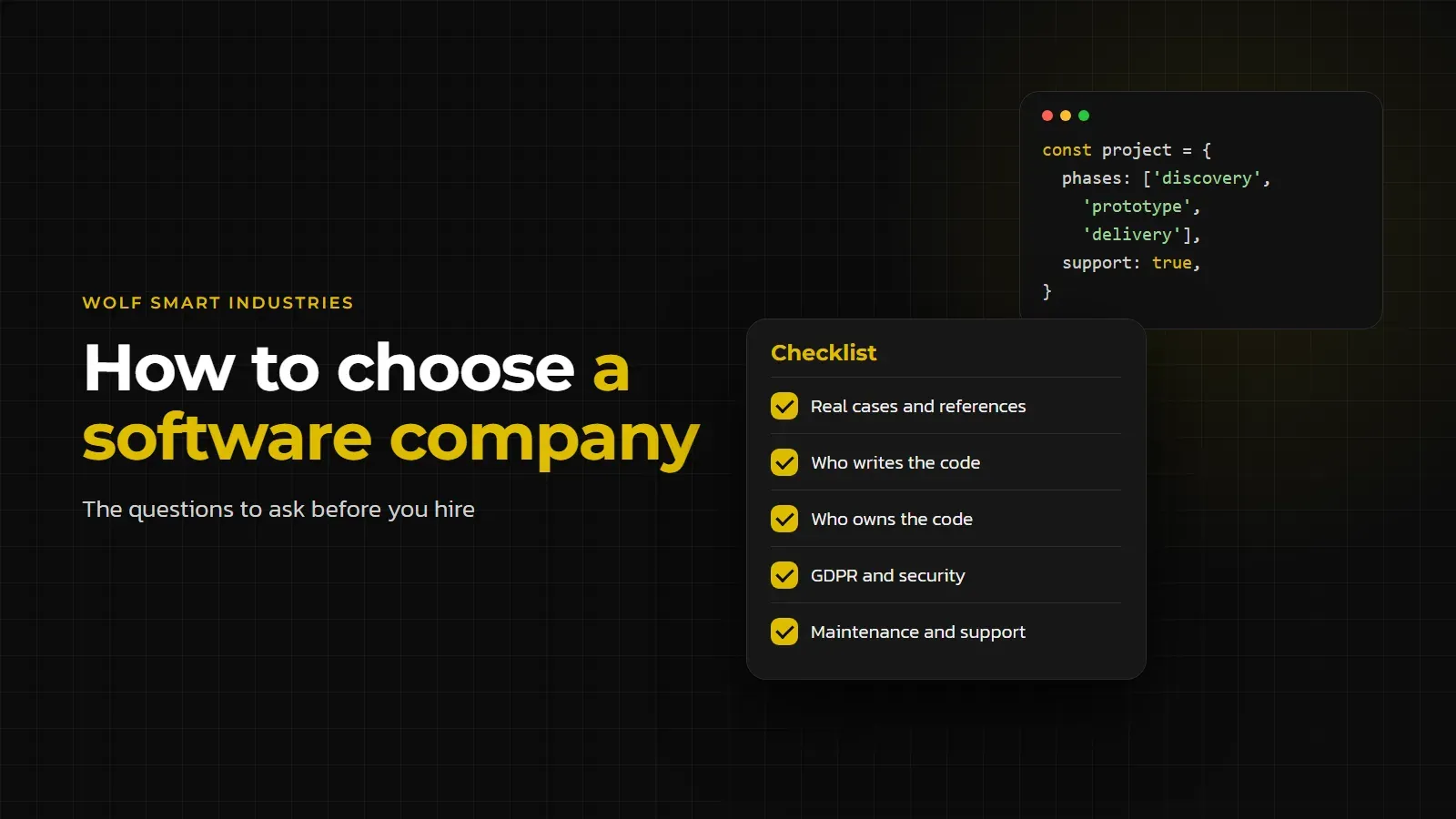
Hiring a software company is a decision that lasts for years: the system it builds will hold your company’s data and shape the way your team works. Even so, many choices come down to comparing the price and timeline of two or three proposals. This guide brings together the questions worth asking before you sign, whether you end up choosing Wolf or someone else.
Portfolio and references: ask for real cases and talk to clients
The best indicator of what a software company will do for you is what it has already done for businesses like yours. Ask for concrete cases: what problem the client had, what was built and what changed. Generic screenshots or a wall of logos tell you very little.
Then ask to speak to one or two of those clients, and ask them how deadlines went, how surprises were handled and whether they would work with the same team again. A client coming back is a good sign: at Clevertours, for example, the manager says their trust in the work led them to extend the app into a second phase.
Watch for confidentiality too: a serious portfolio shows the work without exposing the client’s data. In the CardioEasy case, which handles health data, every published screen was recreated with fictitious data.
Who writes the code: an in-house team or subcontractors?
Ask who will actually write the code for your project. Some companies have their own developers; others sell the project and hand the development to third parties, at home or abroad. Subcontracting is neither forbidden nor necessarily bad, but you need to know it is happening, because it changes who knows the code, who answers when something breaks and who has access to your data.
Ask for the profiles of the people who will work on the project, and whether they will still be around for maintenance after launch.
Why a discovery phase before the quote is a good sign
A company that gives you a fixed price after a half-hour conversation is guessing. The safer route is to start with a discovery or requirements phase: understanding how your business works today, which systems need to stay connected and what belongs in the first version.
The outcome should be a document you keep, setting out scope, priorities, technologies and risks. Even if you don’t go ahead with that company, it gives you a basis for comparable quotes from others. When the idea itself is still fuzzy, software consulting can be the right first step.
Fixed price or time and materials: which should you choose?
Both models are legitimate; what matters is that the one chosen fits the project.
| Criterion | Fixed price | Time and materials |
|---|---|---|
| When it makes sense | A well-defined, stable scope | A scope that will evolve, or extra capacity for an in-house team |
| Cost predictability | High, as long as the scope doesn’t change | Depends on the hours actually used |
| Changes mid-project | A change request, quoted separately | Go into the next set of priorities |
| How you stay in control | Through deliveries and acceptance criteria | Through hours logged per task |
| What to insist on | Written scope and acceptance criteria | Transparent time logs and an agreed cap |
Be wary of a supplier that only works one way and can’t explain why.
Who owns the source code and the intellectual property?
The answer must be in the contract, in plain terms. In Portugal, computer programs are protected by Decree-Law 252/94. Its Article 3 says that when a program is created to order, the rights belong to the party it was made for, unless the parties agree otherwise or the purpose of the contract points to a different outcome. In other words, the contract itself can change the rule, so that is where everything needs to be spelt out. If your contract is governed by another country’s law, the default position may be different, which is one more reason to write it down.
Ask for the contract to state:
- who owns the code developed for you, and from when;
- which components already belonged to the supplier (reused modules, in-house libraries) and what licence you receive to use them;
- which open-source software is used and under which licences;
- what you receive at the end: source code, documentation, credentials and data.
This article is general information, not legal advice. For a contract of any real value, have a lawyer review it.
Access to the repository and documentation
Even with ownership clearly defined, the code is only yours in practice if you know where it is and can hand it to someone else. Ask whether the code lives in a Git repository your company can access, how often it is updated and what documentation you will receive: installation instructions, architecture, integrations and a user guide.
GDPR: the software company as a processor (Article 28)
If the software will hold personal data about customers, staff or patients, the company that hosts or maintains it, and therefore has access to that data, processes it on your behalf. Under the GDPR, it is the processor and your company is the controller.
Article 28 says the controller should only use processors that provide sufficient guarantees, so choosing well is also a legal duty. The same article requires a contract stipulating, among other things, that the processor:
- processes the data only on documented instructions from your company;
- ensures the people handling the data are bound by confidentiality;
- takes the security measures required by Article 32;
- does not engage another processor without prior written authorisation;
- deletes or returns the data, at your choice, when the service ends;
- makes the necessary information available and allows for audits.
Security, hosting and who manages the servers
Article 32 of the GDPR is a handy checklist for security questions: pseudonymisation and encryption of data, confidentiality and availability of systems, the ability to restore data promptly after an incident, and regular testing of the measures in place.
In practice, ask where the system is hosted and in which country, who manages the server and its updates, how often backups are taken and whether a restore has actually been tested. Check whose name the server and domain are registered in, and who holds the admin credentials. If the company offers server management and hosting, ask for these answers to go into the contract.
Maintenance and support after launch (SLA)
Launch is the start of the software’s life, not the end. Ask what maintenance covers (bug fixes, security updates, new features), how you raise a request and how quickly you get a response. Those response times belong in a written service level agreement (SLA) that distinguishes between a failure that stops the business and a request for an improvement.
Communication and project management
Find out from day one who your point of contact is, how often you will see progress and where you can follow the tasks. Projects split into phases, with demos of what already works, let you correct course early. Agree too how changes to scope will be handled, so there are no surprises on the invoice.
Checklist: 12 questions and the answers you should hear
| Question | The answer you should hear |
|---|---|
| Can you show me projects similar to mine? | Real cases, with the problem, the solution and what changed |
| Can I speak to some of your clients? | Yes, with one or two contacts |
| Who will write the code? | The team’s profiles and, if anything is subcontracted, which parts and to whom |
| How do you define what will be built? | A discovery phase, with a scope document I keep |
| Fixed price or time and materials? | The model that fits the project, and why |
| Who owns the source code? | The answer written into the contract, including reused and open-source components |
| Will I have access to the repository and documentation? | Yes, and what is handed over at each phase and at the end |
| Will you sign a GDPR processor agreement? | Yes, covering the points in Article 28 |
| What security measures do you apply? | Concrete measures: encryption, permissions, backups, testing |
| Where is it hosted and who manages the server? | The location, who is responsible, the backups and who holds the credentials |
| What does support after launch include? | Fixes, security and new features, with response times in writing |
| What if we want to change supplier? | Handover of the code, data and documentation, on the terms in the contract |
Red flags when choosing a software company
- A fixed quote with no questions about how you work.
- No real cases and no client you can talk to.
- Nobody can tell you who writes the code, or the team changes without notice.
- The contract is silent on source code, data and exit terms.
- You are told the GDPR doesn’t apply to a system holding customer data.
- Server and domain in the supplier’s name, with no credentials for your company.
- Everything is urgent, with no phases, no testing and no demos.
When you don’t need to hire a software company
If an off-the-shelf product already does almost everything you need, use it: it is faster and cheaper. If you already have developers and only lack capacity for a few months, hourly development and team augmentation may be enough. And if you aren’t yet sure what you want to build, start with a discovery phase before asking for development quotes.
How we work at Wolf Smart Industries
We are a software engineering team in Braga, in northern Portugal, founded in 2021 and recognised by ANI, the Portuguese National Innovation Agency, as a technology-sector company. We have more than five years of experience and 268 projects delivered, for businesses in Portugal, Spain, the Netherlands and Switzerland.
In custom software development we start with analysis: gathering requirements, defining the architecture and planning the integrations with the systems you already use. We split the project into phases, starting with the features that have the most impact. After delivery, we install the system, train your team and carry on with ongoing maintenance: bug fixes, security updates and new features. When a client needs it, we also look after hosting, with daily backups and monitoring.
Whichever company you choose, take these 12 questions to the meeting and ask for the answers in writing. The difference between the proposals will become much clearer.
Sources
About the author

About the author
Wolf Smart Industries
Wolf Smart Industries is a software engineering company based in Braga, Portugal, founded in 2021. It builds custom software, apps and applied AI for businesses in Portugal, Spain, the Netherlands and Switzerland, and installs home automation under the Wolf Smart Home brand. It is recognised by ANI, the Portuguese National Innovation Agency, as a technology company.
Meet the team