


Published 5 min read By Marcelo Fernandes
Short answer
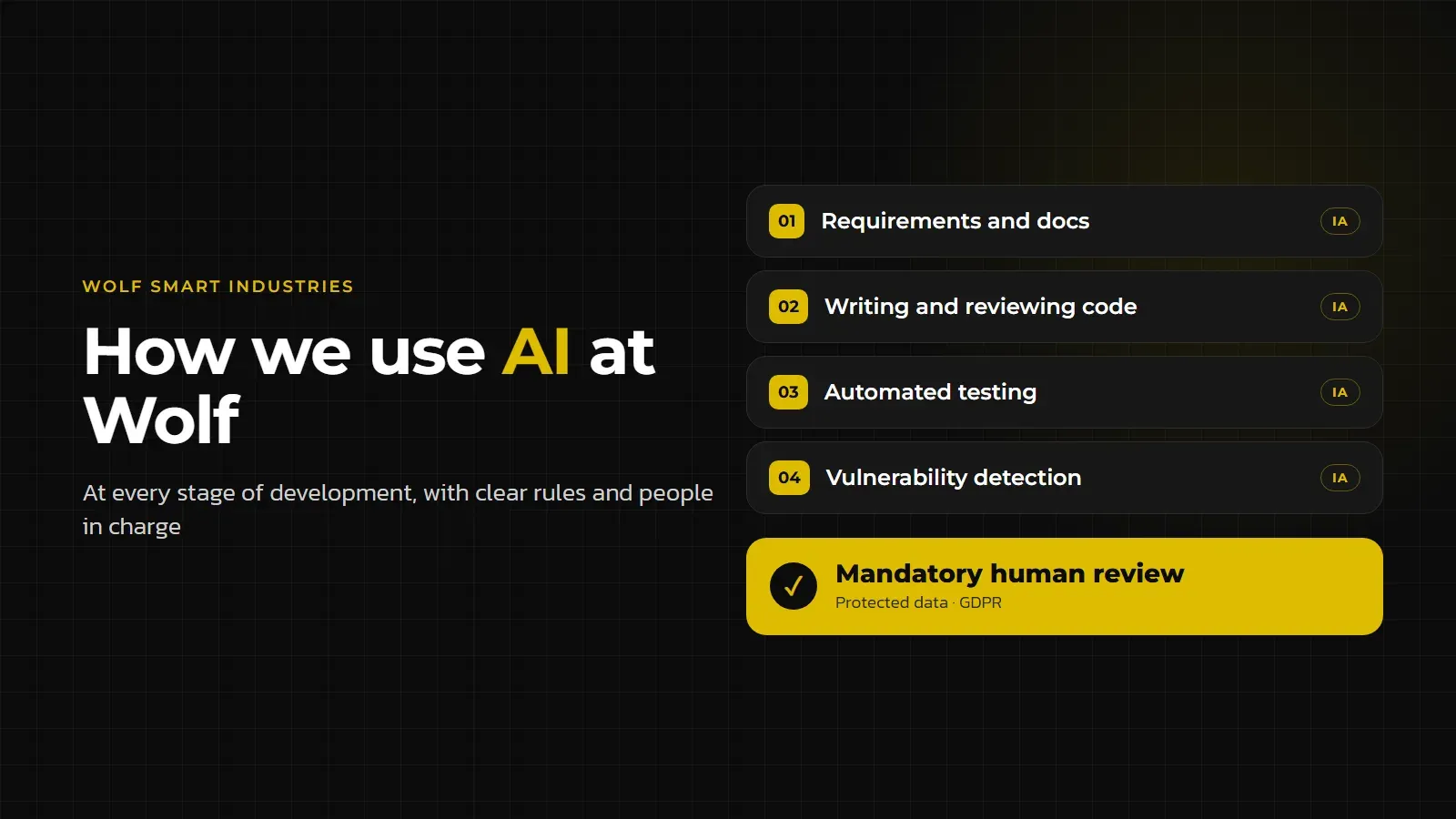
At Wolf Smart Industries, AI helps in four stages of development: requirements analysis and documentation, writing and reviewing code, automated testing and vulnerability detection. Four rules apply: mandatory human review, client data kept out of public AI tools, approved tools only and ongoing training for the whole team.
Today, almost every technology company says it uses artificial intelligence. Few explain how, what for and under which rules.
At Wolf Smart Industries we prefer to be transparent. AI is part of our everyday work: it helps us write better code, test more, catch flaws earlier and deliver smarter solutions to our clients. But we use it on top of a foundation we have been building since 2021, with clear rules and always with people in charge.
In this article we open the door and show how it works.
AI at every stage of development
We use AI throughout the whole life of a project, from the first conversation with the client through to maintenance.
| Stage | What the AI does | Who decides |
|---|---|---|
| Requirements analysis and documentation | Structures requirements, flags gaps and contradictions, keeps documentation up to date | The team, with the client |
| Writing and reviewing code | Speeds up writing and flags errors, duplicated code and breaches of our rules | A developer on the team |
| Automated testing | Creates more tests and covers more scenarios, including unlikely cases | The team validates every release |
| Vulnerability detection | Looks for known security flaws and bad practices | The team fixes and approves |
1. Requirements analysis and documentation
At the start of every project, AI helps us organise what we hear from the client: structuring requirements, identifying gaps and unanswered questions, and spotting contradictions before we write a single line of code. Throughout the project, it helps keep the technical documentation complete and up to date, an essential task that is often left behind.
2. Writing and reviewing code
Our team uses AI assistants to write code faster and more consistently, always on top of our own codebase and standards. In code review, AI works as an extra pair of eyes: it flags errors, duplicated code, performance problems and departures from our rules, before the final review is done by a developer on the team.
3. Automated testing
Testing well is one of the things that most affects the quality of software, and also one of the most time-consuming. With AI, we write more automated tests and cover more scenarios, including unlikely cases that would easily slip past a manual test. More tests mean fewer surprises for the people using the software.
4. Vulnerability detection
AI helps us analyse the code for known security flaws and bad practices, such as poorly validated data, improper access or outdated dependencies. It is one more layer of protection, on top of the security best practices we follow in every project.
What this changes for our clients
AI is not an end in itself. What matters to us is what it lets us deliver to the people who trust us:
- Higher quality. More tests, more reviews and more checks in every release, with less room for error.
- Better security. Vulnerabilities caught earlier, when they are easier and cheaper to fix.
- Faster delivery. Time saved on repetitive tasks speeds up releases and lets the software evolve more quickly.
- More time to think. The team puts more energy into what no machine does for us: understanding the client’s business and designing the right solution.
The secret is in the combination. AI is very good at speeding things up and checking them; our team knows what needs to be done and why, because it has been doing it since 2021, with its own codebase and know-how. That is also why we never subcontract development: the AI works on foundations we know and control.
The AI we deliver to our clients
As well as using it internally, we help other companies put AI to work for them.
Process automation
Emails that answer themselves, documents that are classified and routed, data that moves from one system to another without anyone copying it by hand, reports that prepare themselves. With our AI automation, teams stop spending hours on repetitive tasks and focus on what really adds value to the business.
We always start by understanding the current process and identifying where automation pays off. Not everything should be automated, and we would rather say so up front.
Websites with GEO
More and more people ask ChatGPT, Gemini or Perplexity instead of searching on Google. We build websites with GEO (Generative Engine Optimization), designed to be understood, cited and recommended by these AI engines, without neglecting traditional SEO. That is what we did, for example, on the Clever Travel Group website.
Our rules
AI is a powerful tool, and that is exactly why it needs rules. These are the ones we follow, without exception:
- Mandatory human review. No code, test or document generated with the help of AI reaches a client without being reviewed and approved by a member of the team. The responsibility is always ours, never a machine’s.
- Client data is protected. Our clients’ personal data and confidential information are not shared with public AI tools. Privacy and the GDPR come first.
- Approved tools only. The team only uses AI tools assessed and approved by Wolf, with security and privacy guarantees. No experiments with real data.
- Ongoing training. The whole team is trained to use AI well: to make the most of what it does best, recognise its limits and spot when it gets things wrong.
Using AI without rules is fast. Using AI with rules is what lets us be fast and trustworthy at the same time.
Cutting-edge technology, with our feet on the ground
AI is here to stay and it is changing how software is made. At Wolf we embrace that change with enthusiasm, but without rushing to cut corners. We use it to do better what we have always done: quality software, secure and designed for the people who will use it.
Want to see how AI can help your business, whether by automating processes, getting found by AI engines or training your team? Get in touch.
About the author